You finish the project, push the notebook to GitHub, add the link to your CV, and nobody opens it.
That is the usual outcome. A hiring manager with sixty applications does not read a notebook. They skim a README if it exists, look at whether the repository has recent activity, and move on.
Which is frustrating, because the project is frequently the strongest thing a candidate has. Somebody who has genuinely built a model, cleaned real data and dealt with the mess that follows has demonstrated far more than a certificate does.
The gap is presentation. A notebook is a record of what you did. It is not an explanation of why, and the why is what gets you the interview.
A five-minute recorded walkthrough can close that gap, and an AI Avatar Generator with realistic presentation features from Higgsfield can help create one. However, its role should remain limited, and that boundary matters more than the capability.
Why Does Nobody Open the Notebook?
Because reading code is slow and a hiring manager has sixty of these.
A notebook requires somebody to work out what you were doing, follow the logic, and infer the reasoning from the implementation. That takes fifteen minutes per candidate and nobody has fifteen minutes per candidate.
What actually happens:
- The repository gets a glance, mostly at the README and the commit history
- The notebook gets scrolled, with somebody looking at the plots rather than the code
- The conclusion gets skimmed, if there is one
- A decision gets made in under two minutes
That is not laziness. It is the only way to process a stack of applications, and understanding it changes what you should produce.
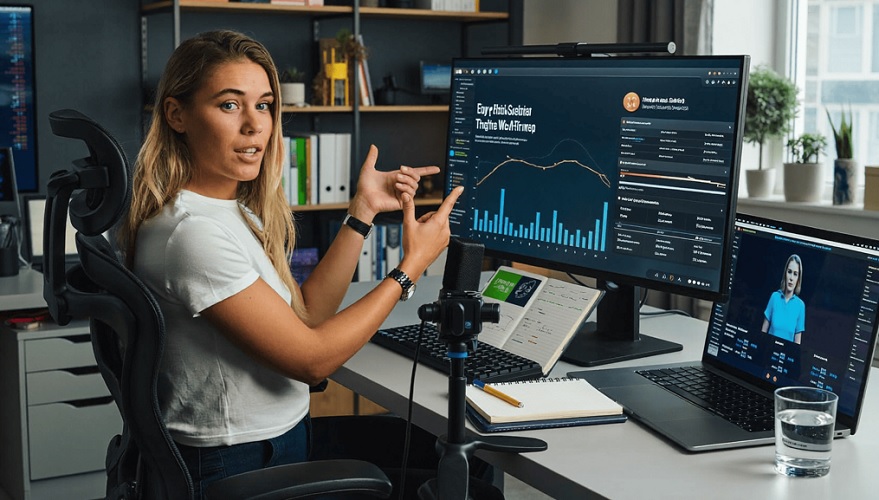
A walkthrough inverts the effort. You spend an hour explaining it once, and every reviewer gets the explanation in five minutes instead of reconstructing it in fifteen.
What Should a Walkthrough Actually Cover?
The reasoning, which is the part a notebook cannot show.
Reviewers are assessing whether you can think, not whether you can import a library. The structure that demonstrates that:
- The problem, stated in one sentence, in business terms rather than technical ones
- Why this approach, including what you considered and rejected
- What the data was actually like, meaning the mess rather than the clean version
- One decision you had to make and how you made it
- The result, with its limitations stated
- What you would do with more time
That fourth point carries the most weight. Every real project involves a judgement call with no clear right answer, and explaining one honestly shows more capability than any accuracy figure.
Keep it to five minutes. Reviewers watching a sixteen-minute walkthrough stop at three.
What Must Never Be Claimed?
A result you did not achieve. This is the line and it is absolute.
Data science has a specific vulnerability here because metrics are easy to state and hard to verify from a video. It is also the field where misrepresentation is caught fastest, because technical interviews probe exactly this.
- Never inflate an accuracy, precision or recall figure
- Never present a result from the training set as though it were test performance
- Never omit that your dataset was tiny or heavily imbalanced
- Never claim a model is in production if it is not
- Never present somebody else’s work, including a tutorial you followed, as your own project
The tutorial point deserves attention because it catches honest people. Following a course project is a legitimate way to learn, and presenting it as original work is not. The honest version is saying so and explaining what you changed or extended, which reviewers respect.
Interviewers ask follow-up questions. “Why did your accuracy drop when you added that feature” is a question somebody who did the work can answer and somebody who did not cannot.
Where Does an AI Avatar Generator Fit?
Around the recording, not in place of you, and the AI Avatar Generator boundary is firm.
- AI Avatar Generator intros and outros, so the piece has structure rather than starting mid-sentence
- AI Avatar Generator transitions between sections, which otherwise cut abruptly
- AI Avatar Generator title and section cards, giving a reviewer a sense of where they are
- AI Avatar Generator context and framing for the problem statement, where there is nothing to show on screen yet
- Consistent AI Avatar Generator treatment across several project videos, so a portfolio looks deliberate
Higgsfield runs an AI Avatar Generator in the browser, which matters for a student working on a shared machine or a laptop that struggles with editing software.
What an AI Avatar Generator must never produce is you. A recruiter is assessing whether they want to work with a person, and a synthetic presenter removes the only thing the video existed to show.
The same applies to your screen. The code, the plots and the outputs have to be your actual work, recorded from your actual notebook.
How Should the Screen Recording Be Done?
From the real notebook, with the font size increased.
- Increase your font size substantially before recording, since a reviewer may watch on a phone
- Close everything else, including browser tabs that reveal what you were googling
- Scroll slowly, because you know where things are and they do not
- Show the output, not just the code that produced it
- Highlight what you are discussing with the cursor
The font size point is the one everybody forgets. Code recorded at your normal editor size is unreadable on anything smaller than a laptop, and a meaningful share of reviewers will open it on a phone.
Record the screen and your voice together rather than separately, which keeps them in sync and takes a quarter of the time.
What Makes the Plots Worth Showing?
Clarity, and most project plots fail it.
A reviewer glancing at your visualisations is forming an impression of whether you can communicate, which is a stated requirement in almost every data role.
What separates a plot that helps from one that does not:
- Axis labels with units, which are missing more often than they are present
- A title stating what the plot shows, rather than the variable name
- One message per figure, not four comparisons at once
- Readable at the size it appears, meaning the fonts are large enough
- Colour that survives greyscale, since not everybody sees colour the same way
Default library output is rarely presentation quality. Five minutes adjusting labels and sizing turns a plot from something you made for yourself into something somebody else can read.
For anybody still building the underlying skills, the Python tutorials library covers the visualisation side alongside everything else.
Which Projects Are Worth Recording?
Fewer than you have, and not necessarily the most technically complex.
- One project with real, messy data, which demonstrates more than a clean dataset ever will
- One that solves something recognisable, where a non-technical reviewer understands the point
- One where something went wrong and you fixed it, which is the most interesting story available
- Not five variations on the same tutorial, which reviewers spot immediately
A portfolio with three well-explained projects beats one with eleven notebooks. The eleven signal volume. The three signal judgement.
If every project you have is from a course, pick one and extend it. Change the dataset, add a feature, deploy it somewhere, or write the evaluation the course skipped. That extension is yours and it is what you talk about.
Does This Help in the Interview Itself?
Considerably, and in a way most candidates do not anticipate.
Recording a walkthrough forces you to articulate your reasoning out loud, which is exactly what a technical interview asks for. Candidates who have done it once perform noticeably better, because they have already found the places where their explanation falls apart.
- You discover what you cannot explain, which is where to study
- You rehearse the narrative you will give in the room
- You hear your own filler words, which is unpleasant and useful
- You find the weak decision you made and can prepare an honest answer
Watch your own Higgsfield recording back. It is uncomfortable and it is the fastest route to a better interview.
Keep the Higgsfield project so the next walkthrough starts from a structure rather than a blank screen.
Does the README Still Matter?
Considerably, because it is what gets seen before anything is clicked.
A repository with no README reads as abandoned. One with a good README reads as somebody who finished the job, and finishing is the quality employers are actually testing for.
What belongs in it:
- One sentence saying what the project does, at the very top
- The result, stated honestly, with its limitation
- A link to the walkthrough video, prominently
- How to run it, assuming the reader has nothing installed
- What the data was and where it came from
- What you would change, which signals self-awareness
Put the video link above the fold. A reviewer scanning a repository decides in seconds, and a link buried under an installation section is a link nobody reaches.
A simple AI Avatar Generator thumbnail for that link does more than a bare URL, since it signals there is something to watch rather than another document to read.
And write the README last, when you know what the project turned out to be. Written at the start it describes an intention rather than a result.
Where Should the Video Live?
Somewhere a reviewer can reach in one click, without an account.
- AI Avatar Generator output unlisted on a video platform, linked from your CV and your repository README
- Embedded in the README itself, which almost nobody does and which works well
- Linked from your profile, where recruiters actually look
- Not attached to an email, since large files get stripped
Put the link where the notebook link currently is. The notebook stays available for anybody who wants it, and the video is what gets watched.
And name the Higgsfield export properly. A file called final_v3 tells a reviewer something you would rather it did not.
What Would One Project Take?
Two hours, most of it on the script.
- Write what you want to say first, as bullet points rather than a script to read
- Increase the font size in your notebook
- Record the screen and voice together into Higgsfield, in one take if you can
- Keep it under five minutes, cutting the setup rather than the reasoning
- Produce the intro and transitions in an AI Avatar Generator
- Watch the Higgsfield cut back before publishing anything
Then do the second one, which takes forty minutes because the AI Avatar Generator structure already exists.
The writing is the part that makes it good. Recording without a plan produces a rambling fifteen minutes that nobody finishes, and you will know within the first minute of watching it back.
FAQ’s
Why does nobody look at the GitHub repository?
Reading a notebook takes fifteen minutes per candidate and reviewers have sixty applications. A walkthrough gives them the explanation in five.
How long should a walkthrough be?
Under five minutes. Reviewers watching sixteen minutes stop at three.
Can an AI Avatar Generator present the project?
No. A recruiter is assessing a person, and a synthetic presenter removes the only reason the video exists. It handles the intro, the transitions and the title cards.
Is a tutorial project acceptable in a portfolio?
Yes, if you say so and explain what you extended. Presenting it as original is what causes problems, and follow-up questions expose it.
What should the walkthrough emphasise?
One decision you had to make and how you made it. That shows more capability than any accuracy figure.
Is there a free way to try this?
Higgsfield operates a free tier as part of an AI creative suite, which covers producing the intro and transitions for one project.
Conclusion
A completed data science project is frequently the strongest evidence a candidate has and the least likely thing to be looked at, because reading somebody else’s notebook is slow.
An AI Avatar Generator handles the structure around a walkthrough, and Higgsfield runs it in a browser on whatever machine you already use.
The explanation stays yours, the screen stays your real notebook, and the numbers stay the numbers you actually got. Somebody is going to ask you about them in a room.